
A Practical Look at the SHIELD Institutional Governance FrameworkTM
One lesson I have learnt from working in banking, consulting, leadership development and entrepreneurship is that having good people is important, but having good people alone does not build a strong institution.
You can have a very competent CEO, an experienced board and hardworking employees and still have an organization that struggles when a few key people leave.
Sometimes the problem is quite simple. Too much of the organization sits in people’s heads. One person knows the important clients. Another understands how a particular process works. A senior executive has the relationships that make things happen. Certain approvals move quickly only because somebody knows whom to call.
For a while, this can look like efficiency. It becomes a problem when the person leaves.
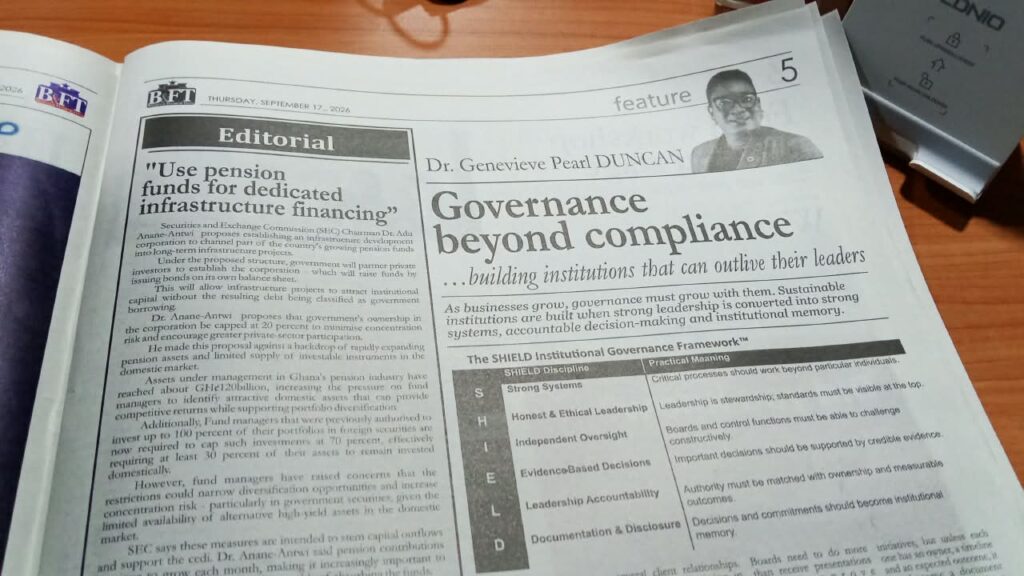
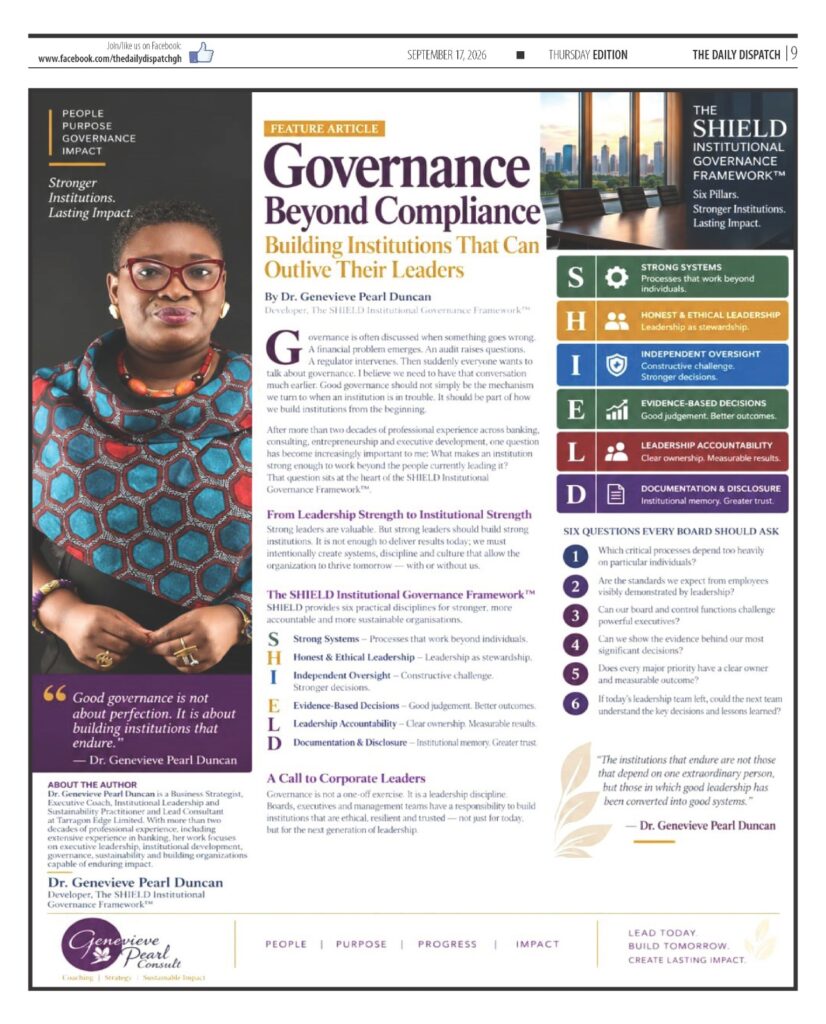
A strong institution must therefore be deliberately built to work beyond the individuals who currently lead it. This thinking has shaped what I call the SHIELD Institutional Governance FrameworkTM, which I developed around six practical areas of institutional leadership:
Strong Systems • Honest & Ethical Leadership • Independent Oversight • Evidence-Based Decisions • Leadership Accountability • Documentation & Disclosure
The framework is not about creating more paperwork. It is about helping leaders build organizations that work consistently, make sound decisions and remain credible as they grow.
Strong Systems
Consider a simple situation. A senior employee leaves an organization and suddenly nobody knows the status of several important client relationships. Passwords cannot be found. Agreements are sitting in someone’s email. A supplier arrangement was made verbally. A process everybody thought was established turns out to have been managed by one person.
That is not primarily a people problem. It is a systems problem.
Strong systems mean that important organizational processes do not depend entirely on particular individuals.
At Tarragon Edge Limited, for example, as we develop programmes, partnerships and client engagements, we also have to think about how that knowledge stays within the organization. Who owns a client relationship? Where is the agreement? Who approved the expenditure? Where is the programme methodology? If the person managing the assignment is unavailable tomorrow, can someone else continue the work? These are ordinary questions, but they are governance questions. Good governance often begins with getting the basics right.
Honest and Ethical Leadership
Policies matter, but employees pay more attention to what leaders actually do. If a company says procurement must follow a process but senior executives routinely bypass it, employees quickly understand which standard is real.
If leaders demand punctuality but consistently arrive late, that communicates something. If junior employees are disciplined for behaviour that is tolerated at senior level, that also communicates something.
Ethical leadership therefore has to be visible in everyday decisions. This is why I see leadership as stewardship. A CEO, director or manager may control significant resources, but those resources do not personally belong to the leader. The leader has been entrusted with them for a period. That distinction changes the way we exercise authority.
Independent Oversight
Good leaders need people around them who can disagree with them. This is particularly important as an organization becomes successful. Success can sometimes make challenge more difficult because people assume that the person who has been right several times will continue to be right.
Boards therefore need to do more than receive presentations and approve recommendations. They need to ask questions: Why are we making this investment? What are the risks? What assumptions are we making? What happens if the plan does not work? What alternative did management consider?
The same principle applies below board level. Finance, audit, risk, compliance and other control functions must be able to raise concerns without being treated as obstacles to business. Sometimes the person slowing down a decision is actually protecting the institution.
Evidence-Based Decisions
Executives make decisions every day, and experience naturally influences those decisions. But experience should not replace evidence.
Suppose an organization wants to open another branch. The CEO may like the location. A director may know the landlord. Someone may say the area is developing rapidly. Those observations may be useful, but they are not enough.
What is the expected market? What will the branch cost? What revenue can realistically be generated? What does the customer data tell us? What are competitors doing? How long will it take to break even?
Good leadership combines experience with evidence. The same principle should apply when recruiting senior people, entering partnerships, launching products or investing significant resources. Important decisions should be capable of being explained.
Leadership Accountability
One of the practical questions I believe organizations should ask more often is: Who owns this?
When everybody is responsible, sometimes nobody is responsible. A strategic plan may contain twenty initiatives, but unless each initiative has an owner, a timeline and an expected outcome, it can easily become a document that is discussed at meetings without changing the organization.
Accountability does not mean looking for someone to blame. It means creating clarity. What was agreed? Who is responsible? When should it be completed? How will we know it has worked? What happens when it is consistently not delivered?
This applies to executives as much as it applies to employees. In fact, accountability should become stronger as authority increases.
Documentation and Disclosure
Documentation is probably one of the least exciting subjects in leadership, but it is one of the most important.
I have seen situations where everybody remembers a meeting differently. One person says an amount was approved. Another says it was only discussed. Someone believes a partnership was agreed. Someone else believes discussions were preliminary. Six months later, nobody can establish exactly what happened.
A short written record could have prevented the confusion. Documentation protects both the institution and the individuals involved. It also creates institutional memory.
Minutes, contracts, approvals, procedures, client records, intellectual property and important decisions should not disappear when employees leave. This becomes even more important as organizations grow.
What SHIELD Looks Like in an Organization
The practical application of SHIELD does not need to begin with a major consulting exercise. A board or executive team can start with six simple actions.
First, identify the five or ten processes the organization cannot afford to have fail and make sure they are properly documented. Second, review whether senior leadership is consistently operating according to the same ethical standards expected from employees.
Third, check whether the board, audit, risk and compliance functions can genuinely challenge important decisions. Fourth, require significant investments and strategic decisions to show the evidence on which they are based.
Fifth, give every major strategic priority a named owner, deadline and measurable outcome. Finally, identify important organizational knowledge currently held by individuals and begin transferring it into institutional systems.
Those six actions alone can reveal a great deal about the strength of an organization.
The Real Test Comes When People Leave
Leadership transitions are normal. CEOs leave. Board members complete their tenure. Experienced employees retire. Founders eventually step away. The question is what happens next.
If customers disappear because one executive left, there was a relationship but perhaps not yet an institutional relationship. If a process collapses because one employee resigned, there was expertise but not yet an institutional system. If strategy changes completely whenever a new leader arrives, the organization may have leadership but not yet enough institutional direction.
This is why succession should not simply be about identifying the next CEO. Succession should also ask what systems, knowledge, culture and decision-making disciplines the next generation of leaders will inherit.
Building for the Next Generation of Leadership
The institutions that endure are rarely those that depend on one extraordinary person. They are organizations in which good leadership has gradually been converted into good systems.
That is what I hope the SHIELD Institutional Governance FrameworkTM helps boards and executives to think about. Not governance for governance’s sake. Not another policy sitting on a shelf. But practical institutional discipline:
S — Strong Systems
H — Honest & Ethical Leadership I — Independent Oversight
E — Evidence-Based Decisions L — Leadership Accountability D — Documentation & Disclosure
For me, the ultimate test of institutional leadership is quite simple: After we have left, does the organization still know what to do, why it is doing it, who is responsible and what standards must not be compromised?
If the answer is yes, then we have done more than lead. We have built an institution.
About the Author
Dr. Genevieve Pearl Duncan is a Business Strategist, Executive Coach, Institutional Leadership and Sustainability Practitioner and Lead Consultant at Tarragon Edge Limited. She developed the SHIELD Institutional Governance FrameworkTM (2026) as a practical framework for strengthening governance, leadership accountability and institutional sustainability.
Framework Attribution: The SHIELD Institutional Governance FrameworkTM and its six-pillar formulation — Strong Systems, Honest & Ethical Leadership, Independent Oversight, Evidence-Based Decisions, Leadership Accountability, and Documentation & Disclosure — were developed by Dr. Genevieve Pearl Duncan in 2026. Its broader governance principles are informed by established organizational governance and internal-control literature.
© 2026 Dr. Genevieve Pearl Duncan. All rights reserved.